The Expeditioners and the Treasure of Drowned Man's Canyon by S. S. Taylor
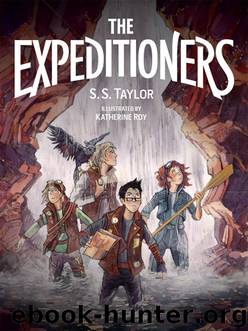
Author:S. S. Taylor [Taylor S.S.]
Language: eng
Format: epub, mobi
ISBN: 9781938073670
Publisher: McSweeney's
I got out the map and laid it out carefully by the fire so I could study the route and check it once again for any sign of where the old mine might be. We would be hiking farther into the canyon tomorrow and we still had no idea where to look. With the Nackleys behind us, we didn’t have much time.
As I studied Dad’s map, I was bothered again by the fact that the entrance to Drowned Man’s Canyon hadn’t been where it was supposed to be. According to Dad’s scale, it should have been eight miles along the floor of Azure Canyon. But we had entered it at five miles. What had happened to those additional three miles? Time and rivers could make canyons wider and longer, but nothing could have altered where the canyon started.
“What are you doing?” M.K. asked, coming to sit beside me.
“I don’t know. There’s something funny about this map.” I showed her how I’d compared it with the tourist map that Bongo had given us and my own calculations as we’d ridden through the canyon, and found that Dad’s map was wrong.
“But he was never wrong,” I muttered, as much to myself as to M.K. I fooled around with the two halves of the map, making sure I’d matched them up precisely. They fit perfectly when I placed the two halves together so that they didn’t overlap at all, but I started experimenting, overlapping the edges and trying to match up the contour lines representing the depth of Drowned Man’s Canyon on one side with the lines on the other side.
Dad’s map represented Drowned Man’s Canyon as a series of closely spaced squiggling contour lines, each one representing points connected at the same elevation.
Contour lines were only invented in the sixteen hundreds, when a French mapmaker came up with them as a way of representing the actual features of a landscape, the mountains and valleys and lakes and rivers. Until then, maps had been able to represent places in only one dimension. You could draw a blue circle for a lake, but you couldn’t see how deep the lake was or how steeply the edges of it dropped off toward the middle. You could draw mountains and hills, but on paper Mount Everest would appear to be the same height as a little foothill. But once topographical maps—that is, maps that represented the rising and falling of the landscape—came along, you could read a map on paper or on a Muller Machine and get a feel for the landscape, for whether it was flat or hilly or wet or dry. It was funny, sitting in the cave high in the walls of Drowned Man’s Canyon, looking at a map representing those walls.
I shifted the sides of the map.
“Wait a second,” I said. Zander and Sukey looked up from their conversation.
“What?” M.K. watched as I fiddled with the edges of the two halves, overlapping them and then making a few calculations. Instead of matching
Download
The Expeditioners and the Treasure of Drowned Man's Canyon by S. S. Taylor.mobi
This site does not store any files on its server. We only index and link to content provided by other sites. Please contact the content providers to delete copyright contents if any and email us, we'll remove relevant links or contents immediately.
Shadow Children #03 - Among the Betrayed by Margaret Peterson Haddix(11977)
Among the Betrayed by Margaret Peterson Haddix(11659)
Six of Crows by Leigh Bardugo(10315)
Fangirl by Rainbow Rowell(9369)
Harry Potter and the Cursed Child - Parts One and Two Playscript by J.K. Rowling & John Tiffany & Jack Thorne(8193)
Shadow and Bone by Leigh Bardugo(6881)
Ranger's Apprentice 1 - The Ruins of Gorlan by John Flanagan(5978)
The Silver Mask by Holly Black & Cassandra Clare(5586)
The Ballad of Songbirds and Snakes (A Hunger Games Novel) (The Hunger Games) by Suzanne Collins(5109)
Siege and Storm by Leigh Bardugo(5048)
Percy Jackson 1 - The Lightning Thief by Riordan Rick(5029)
His Dark Materials 1 - The Golden Compass by Philip Pullman(4625)
Harry Potter and the Cursed Child: The Journey by Harry Potter Theatrical Productions(4557)
Papillon (English) by Henri Charrière(4337)
The miraculous journey of Edward Tulane by Kate DiCamillo(4172)
Predator's Gold by Philip Reeve(3878)
Erebos by Ursula Poznanski(3816)
Good by S. Walden(3632)
Harry Potter and the Prisoner of Azkaban by J K Rowling(3619)
